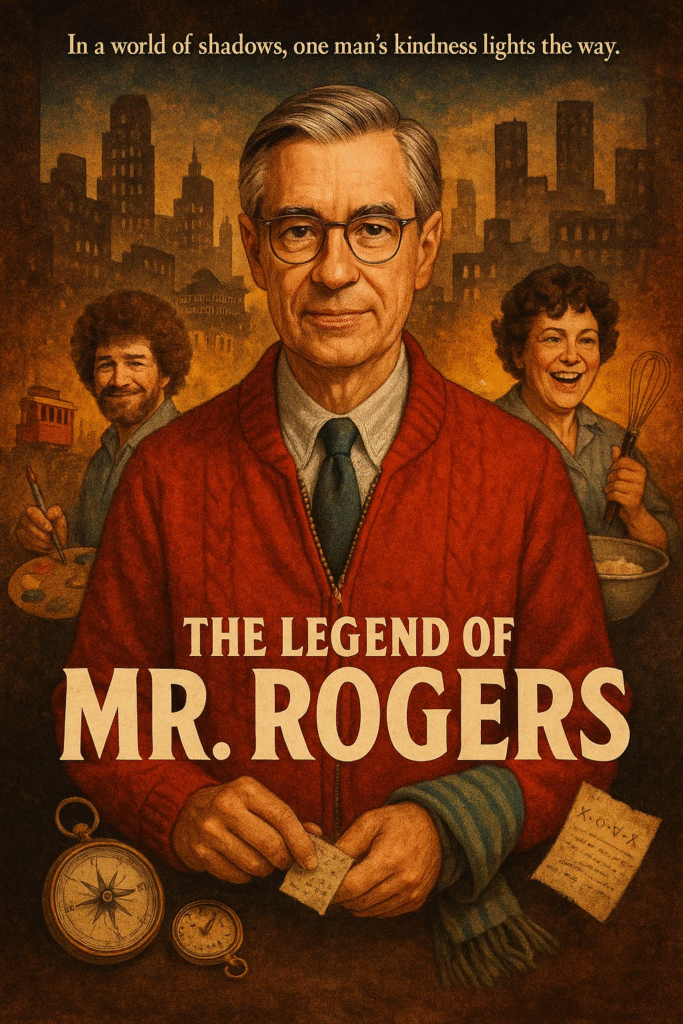
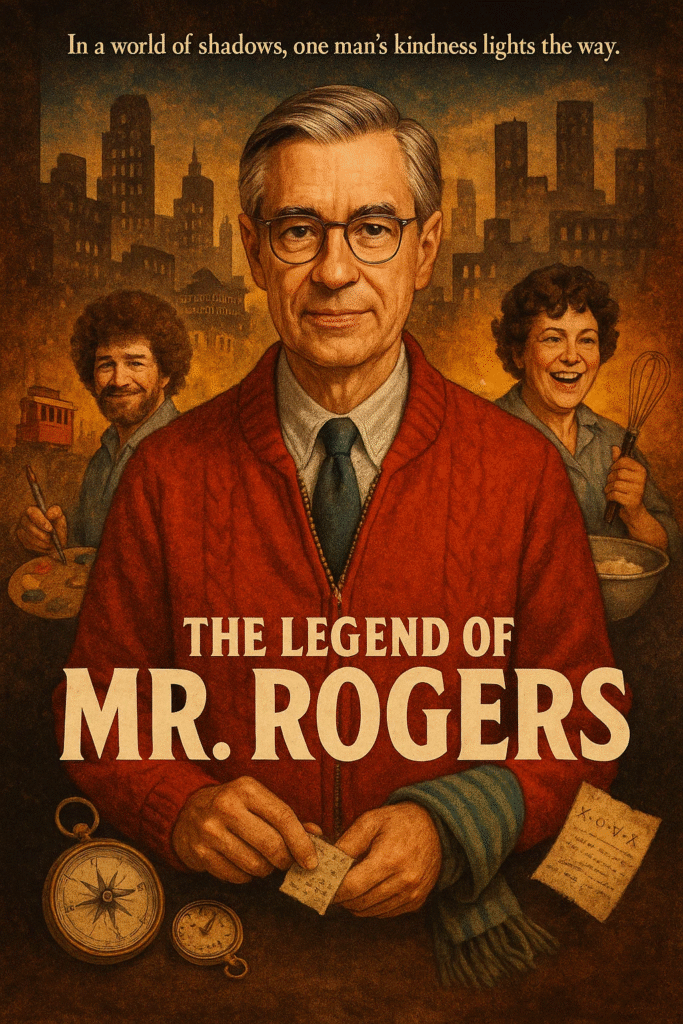
Chapter Two cracks open the story’s ribs—listen close, because this is where the heartbeat changes.
Chapter 2: The Undercurrents and the Gathering Storm of Ambition
The city pulsed with the vibrant, sometimes dissonant, symphony of the mid-1970s. Bell-bottomed pedestrians swished past him, the insistent beat of disco music pulsed from open car windows, and the weary groans of air conditioners blended with the distant, rhythmic shouts of street vendors.
Mr. Rogers, guided by his unique blend of intuition and meticulous observation—a radar for the emotional landscape of the urban sprawl—found himself tracing Timothy’s path towards the bustling docks. The young artist, it seemed, had been drawn to the raw, visceral energy of the waterfront, a place where the grime of industry often collided with the spontaneous, uninhibited spirit of burgeoning art.
He walked with his characteristic, unhurried gait beneath a massive scaffold where a new high-rise, a steel skeleton against the sky, was slowly ascending, its unfinished frame glinting like an audacious promise in the afternoon sun. A burly construction worker, his face a mask of sweat and grime, was bellowing directions to a crane operator, his voice rough as raw sandpaper, cutting through the din.
As Mr. Rogers passed beneath the dizzying heights, the worker abruptly stopped, his hard hat tilting back. His hardened gaze, accustomed to measuring girders and assessing risk, suddenly softened, then widened in startled recognition.
“Hey! You! Mr. Rogers!” the man bellowed, his voice momentarily cutting through the cacophony of the construction site like a sharp, clear whistle. He lumbered over, wiping his hands on his denim overalls, his expression shifting from gruff authority to unguarded awe.
“It is you! Jimmy ‘The Hammer’ Harrison! You probably don’t remember, but you talked me out of quitting that plumbing apprenticeship back in ’68, when I was sure I was useless, a washout. You said, ‘Every single day, Jimmy, we’re learning something new about ourselves, and that, my friend, is a truly remarkable thing.’ Best advice I ever got! My son’s going to college on plumbing money now, thanks to you talking sense into my thick skull!” He clapped Mr. Rogers heartily on the shoulder, a blow that would have sent a lesser man reeling, but Mr. Rogers, surprisingly grounded, merely swayed slightly. “Just wanted to say… thanks, neighbor. You always had a way of seeing the good in folks, even when they couldn’t see it themselves.”
Mr. Rogers, subtly adjusting his balance, offered a warm, genuine smile that seemed to momentarily illuminate the harsh construction site. “It’s a wonderful feeling, isn’t it, Jimmy? Knowing you built something lasting, not just with your hands and those pipes, but with your perseverance. Something good for your family.”
He continued on, a small, knowing smile playing on his lips. His unique brand of investigation—one part keenly honed observation (a skill sharpened in much harsher landscapes than this urban sprawl), two parts radical, unflinching empathy—was proving astonishingly effective in the often-callous urban jungle. He’d learned, from his time in Vietnam’s shadowy forests, that true understanding wasn’t about brute force or harsh interrogation, but about connection—finding the unseen currents that moved people, the hidden narratives beneath the surface.
But not everyone in the intricate, often cutthroat dance of the detective business shared his quiet, humane philosophy. Across town, in a sleek, coldly modern office of polished chrome and tinted glass, two men in impeccably tailored suits studied a grainy, poorly lit photo of Mr. Rogers, tacked to a dartboard. “Rogers Investigations,” the crude, mocking target read, pierced by several darts.
“The old man’s cutting deep into our missing persons market,” sneered Sterling Thorne, his voice a low, reptilian hiss, barely concealing a simmering rage. Thorne was the slick, ambitious, and utterly ruthless head of Thorne & Associates, a firm built on aggressive tactics, corporate espionage, and a chilling, almost celebratory, disregard for ethics. “All this ‘kindness’ and ‘neighborly’ nonsense. It’s bad for business, Brick. People are starting to prefer his… methods over ours. He makes us look… inefficient.”
His partner, a hulking, silent man named Brick, grunted, his eyes unreadable, like dull stones. “He found the Senator’s kid in three days. Took us a week just to get a lead on that one, and we had the inside track, paid off half the department.”
“Exactly,” Thorne spat, a dart glinting in his hand as he plucked it from the board with a sharp snap. “He needs to be… redirected. Permanently. The city needs to remember who really controls the flow of information, where the real power lies, and who isn’t afraid to use it.” He aimed the dart, with chilling precision, at Mr. Rogers’s forehead in the photo, a malicious gleam in his pale eyes. “We’ve got a new, high-profile missing persons case coming in, a very valuable art collection, vanished without a trace, and the collector’s son seems suspiciously involved. Let’s make sure Mr. Rogers gets tangled up in it. In a way he won’t untangle easily. And when the dust settles, his little ‘Neighborhood’ will be nothing but a forgotten address, a quaint, irrelevant memory.”
The trap was already being set, a meticulously crafted web designed to ensnare a man who only sought to help, a gentle soul in a ruthless world. Timothy’s case, which had innocently led Mr. Rogers to an unassuming art commune, was about to become the unsuspecting conduit for a far darker, more sinister scheme. The quiet currents of kindness were about to collide head-on with the turbulent undercurrents of pure, unadulterated malice. The storm, long brewing, was about to break.
The Gentlest Touch and the Echoes of a Distant War
Before the chase begins, before the conspiracy unfolds—there’s the man you think you know.
🎧 Listen to the audio version:
The bell above the door of “Rogers Investigations” chimed, a friendly, almost melodious sound that had, over the years, become synonymous with a fragile glimmer of hope for the lost and the found. It was 1974, and outside, the city was a tumultuous kaleidoscope of changing times: flared pants and platform shoes, the distant rumble of social unrest, and the faint, optimistic strains of a new pop song bleeding from a passing car. Inside, however, time seemed to deliberately slow, held captive in the amber glow of a single desk lamp, the comforting, almost nostalgic scent of pipe tobacco and faint lavender, and the quiet, immovable presence of Frederick Rogers. His familiar red cardigan, today, was a vibrant splash against the calming, neutral tones of his office, its fabric a soft, reassuring balm against the anxieties of the world. He sat behind a sturdy wooden desk, not polishing glasses now, but meticulously cleaning a small, well-worn pocket compass—a deeply ingrained habit from a life long past, a silent meditation on true north. The cool, smooth brass felt familiar in his palm, a ghost of a weight from another time, another purpose.
His current client, Mrs. Gable, was a living embodiment of profound grief, her handkerchief a sodden, crumpled mess. Her son, Timothy, a budding artist with a soul as vibrant and unpredictable as his canvases, had vanished three days prior, leaving behind only the haunting quiet of his absence. The police, efficient but perpetually overburdened, had, with polite finality, labeled it a typical case of youthful wanderlust. “He left a note,” Mrs. Gable whispered, her voice a fragile, brittle thread, “about ‘finding inspiration.’ But Timothy wouldn’t just leave without telling me. Not truly. We… we’re close, Mr. Rogers. He always told me everything.”
Mr. Rogers listened, truly listened, with an intensity that seemed to absorb every tremor in her voice, every unspoken fear in her eyes. His gaze was unwavering, deep with an understanding that transcended mere words, rooted in a quiet empathy few possessed. He didn’t interrupt with standard investigative questions about Tim’s habits, or his friends, or even his last known whereabouts. Instead, he asked about the way Timothy hummed when he was happy, a specific, off-key melody. He inquired about the color of light he loved most—the bruised violet of pre-dawn, perhaps? He asked about the tactile pleasure of his favorite brushstrokes, the subtle scent of his preferred oil paints. He listened, with every fiber of his being, to the unspoken language of a mother’s heart, the subtle, unique cadences of her private sorrow. “Sometimes, Mrs. Gable,” he said, his voice soft, yet resonating with a gentle, undeniable authority, “the most important notes aren’t written down at all. They’re felt, here,” he tapped his chest gently, over his heart. “And a mother’s heart, Mrs. Gable, has a very good ear for those unwritten messages. For the true north of a child’s spirit.”
He assured her, not with glib promises of a swift, miraculous return, but with a quiet, resolute commitment to diligent, compassionate attention. As Mrs. Gable finally rose, a faint tremor of nascent hope settling in her shoulders, the bell chimed again. An elderly woman, no taller than Mr. Rogers’s elbow, her frame stooped with the weight of years but her eyes bright with a spark of immediate recognition, peered into the office. She wore a faded floral apron, perpetually smelling of flour and a faint, sweet spice, and in her gnarled hands, she carried a wicker basket from which wafted the irresistible aroma of warm sugar and cinnamon.
“Mr. Rogers? My goodness, is that truly you?” Her voice was thin, but it carried the unexpected clarity of a distant memory. “It’s Beatrice! From the old neighborhood on Elm Street! My goodness, I haven’t seen you since… since you helped little Mikey find his teddy bear under that runaway bus at the Fourth of July parade! He’s a grandfather now, you know! Still talks about ‘the kind man’ who wasn’t scared of anything.”
Mr. Rogers’s smile unfolded, a genuine, radiant thing that seemed to banish any lingering shadows. “Beatrice! My, it’s been a long time. And how is Mikey doing these days? Still as adventurous?”
Beatrice bustled into the office, setting her basket on the corner of the desk, its contents briefly overwhelming the lavender scent with its comforting sweetness. “He’s grand, absolutely grand! Here, I made too many for just myself. You take some, dear.” She pressed a warm, slightly sticky cinnamon bun into his hand, her eyes twinkling with unreserved affection. “You always were a good neighbor, Mr. Rogers. Always. Even back then, you had a way about you, even as a young man. A quiet way of seeing things others missed, of knowing just where to look. Not many folks have that.” Her words hung in the air, a subtle nod to the precision honed not in a classroom, but in the unforgiving jungles of Vietnam, a past that still lingered in his preternaturally sharp senses, though rarely spoken of directly.
As Beatrice finally departed, leaving behind a lingering warmth and the sweet scent of baking, Mr. Rogers turned back to Timothy’s case file. He picked up the crumpled note again, not for the scrawled words, but for the almost invisible indentations on the paper where a pencil had pressed hard, drawing something beneath the actual message. He’d helped a lot of people find lost things, over the years. Some were simple toys, tucked away in forgotten corners. Some were pieces of themselves, fractured by life’s cruelties and hidden deep within. And some, like Timothy, were simply lost children, no matter their chronological age, searching for their own neighborhood in a world that often felt too vast, too loud, and too indifferent. He knew where to start looking, not in police reports, but in the quiet, unconventional places where creativity bloomed and, sometimes, people got a little too inspired, forgetting the path home.
By Aeric Adams FilmScribe / Forked Up – Cinematic Critic, Chaos Enthusiast & Sentient Popcorn Bucket Published: July 2025
🍿 Quick Verdict
“Better than most of the live-action Transformers movies combined—and somehow has more soul.”
⭐ Rating
★ ★ ★ ★ · (4 stars) – 89% Certified Fresh
📽️ The Rundown
Directed by Josh Cooley, featuring voices by Chris Hemsworth, Brian Tyree Henry, and Scarlett Johansson. An animated origin story exploring the formative journey of Optimus Prime and Megatron. Runtime: 1 hr 36 min. In theaters now.
🎭 What Works
A layered hero’s journey that actually feels earned.
Voice performances that bring emotional depth—Hemsworth for the ladies. Scarlett for the fellas.
Visuals that let character shine instead of just chasing explosions.
Clever narrative surprises that don’t feel shoehorned.
💤 What Doesn’t
A few tonal shifts feel rushed.
Some scenes might be leaning too heavily on viewer nostalgia. Eh-I’m Gen X…so-thanks.
One or two punchlines fall flat. Man I am trying! It’s good.
🧠 Aeric’s Take
I came for the clang of metal and ended up feeling something. Transformers One pulls off a rare feat: it makes you care about mythic robots before they were gods—or villains. There’s heartbreak. Brotherhood. Betrayal. It slows down enough to let the heart breathe before the machinery war begins.
This is why myth matters: because action without purpose is just chaos.
🎞️ Best Scene (SPOILERISH)
That cliffside confrontation—Optimus and Megatron as still-friends teetering on the brink of fate, with no soundtrack or fanfare. You feel every…gear…grinding.
🎯 Final Word
Transformers One is a thoughtful, surprisingly poignant reboot; a metallic fable that hums long after the credits roll.
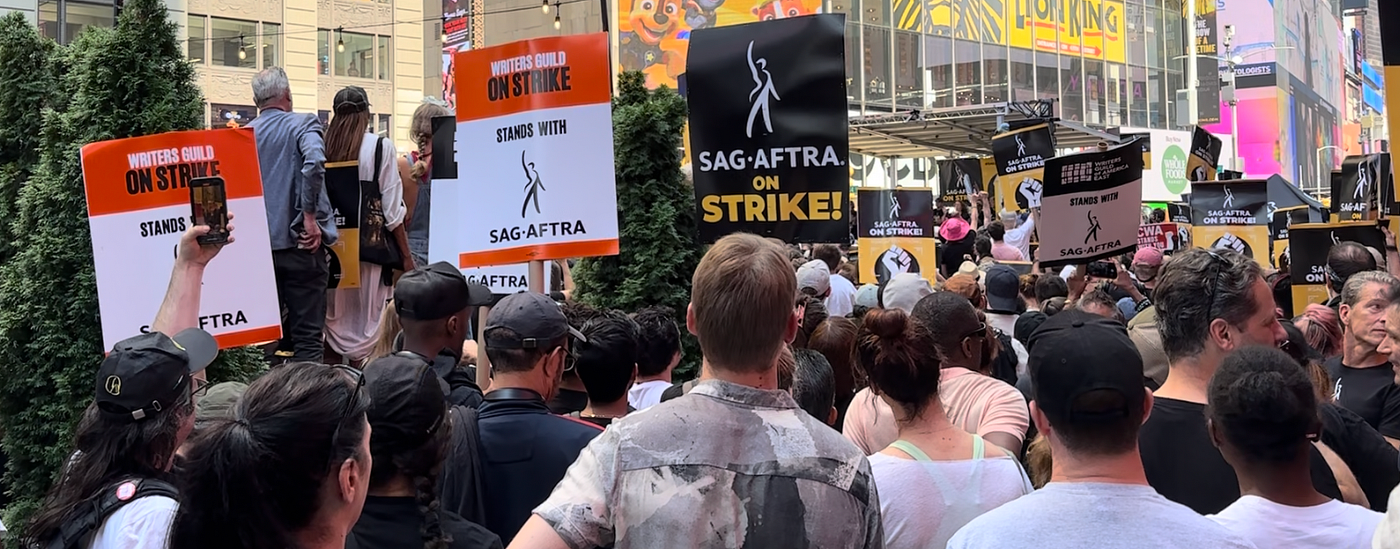
Inside the 2023 Writers/Actors Strike from an…insider.
Photo from Deep Broke
Disclaimer: I work as an Assistant Director, in the Directors Guild of America. On one particular project, I met and became friends with a writer. I asked to interview him.
They shall remain nameless in lieu of the sensitivity of the subject matter.
His statements are a matter of personal point of view, opinion, and in no way reflect the thoughts, opinions, actions, or needs of the Writers Guild of America, its partners, or its subsidiaries.
Before the Beginning
Deep Broke: Make sure you say this. This is the drop you have to put at the top:
Aeric Adams: Okay.
Deep Broke:
“I am not an official representative of the writers guild. I am speaking only for myself. My opinions and analysis are a pure reflection of myself and my own thoughts regarding the strike. These are my observations and they do not represent an official statement of the Writers Guild of America, West or East.”
Aeric Adams: Hey, Deep Broke! How are you?
Deep Broke: I’m Good and I am humbled, today.
A.A.: How Humble?
D.B.: The Writers Guild has a solidarity leaflet with Starbucks. And nothing in this world will humble you more than trying to hand out leaflets and fliers about organized labor, in midtown Manhattan, on a Monday morning, when it’s raining out. Not a single soul wants to make eye contact with you, at all. You get a real sense of your scale in the universe.
A.A.: That is a hell of a morning! You are in the fire. But, I want to build into that. Tell me what you can about you. What’s your origin story?
Who Are You?
D.B.: Alright. I am a writer and producer. I am originally from New York. I joined the Writers Guild [less than ten] years ago. I have a writing partner.
We got our big break working on an episode of an anthology series with [a network]. It was one of their highest rated episodes, so they brought us back to write a few more episodes, for their next season.
We got to know the show runner really well and when it was his time to move on he told the network and producers that my partner and I were good enough to take over the show. So we did.
We produced the entire following season. We were battle tested, because it was under the conditions of covid.
A.A.: How drastic is the difference in the writers room ,pre and post covid?
D.B.: During the pandemic was actually less stressful. People were figuring out how to do things, zoom was still becoming a thing, and a lot could be done over email.
At the height of the pandemic there was actually a nice level of correspondence. When everybody got a handle on it and there were zoom calls and FaceTimes things actually got more chaotic.
A.A.: What was the chaos?
D.B.: It’s very easy to be clear and concise on the page. When you send an email you can edit before you send it. If you are thoughtful, it’s something quick, easy and digestible.
When you are on a zoom it’s the worst of all worlds. You don’t have that grace period to think about what you are saying. It’s a conversation so everything comes out.
You lose the ability to have full body language, so the subtleties in actual conversation disappear. But, all the bullshit that people pick up from a conversation or all the subtext, they take out of it, remains.
We’d be talking to a writer and they’d say ‘I get it! I get it!’ They yes you to death. Yet, it wouldn’t come out in the next draft. Nothing we talked about would be there. In email we just got better results.
Yes, but No
A.A.: Unpack the “yes-man” part for me.
D.B.: This is the unfortunate thing about the industry. We are all sort of conditioned that nobody ever wants to hear no. That is true in life but, particularly in this industry.
There is a notion that if you say “no” you are branded as difficult. So, there is an entire language in this Industry, that has been developed, so people can do so without using the word no.
No one gives harsh criticism.
Instead of saying ‘that’s a really bad idea and you should have never said that, using words, let alone out loud, using English, it turns into ‘Yeah, you know that’s an interesting note, but you know what I am “bumping” on is…’ and then you have to go into why it’s a bad idea.
I’m a New Yorker. My partner is a New Yorker and we are very plain spoken. Like, ‘That sucks.’ And we don’t mean it personally. In a writers room, nothing should be taken personally.
Unless, someone says something about your mother to your face and it’s like ‘F-you,’ none of it is personal. It’s all about the craft. We are all sensitive artists. So, no one takes it this way.
You have to couch it in this bland language of double talk; another reason zoom calls are so horrible. They have to decipher what you are saying.
Writers Room Politics
A.A.: The politics of writers rooms.
D.B.: Yes. There are differences in the types of writers rooms you are talking about. An anthology series is, by nature, sort of singular. Each episode is its own little world.
When you are dealing with one writer it’s a much more intimate relationship. It’s one on one. And what you are doing as a showrunner is crafting that story, with the writer. And serving as an intermediary with that writer, to the network.
Sometimes, it’s successful because you have some good sharp professionals who know how to take notes. Other times, it did not work out. We’d end up having to “page one” the material. The notes we were getting from the network were just painful.
In my first show running gig, my partner and I were also still learning how to take notes from the network. And full disclosure, the network really liked us, they loved our ideas, they loved the work we did, but the biggest problem is that we were horrible at taking notes.
There are these notes where as a writer you say “I don’t understand why they don’t get it!”
A.A.: I see.
D.B.: They will give you a note. And you say ‘Yeah, but what it means is this-‘ And you missed the point where if you have to explain it much it didn’t land on the page. And they didn’t see it.
There’s this saying called “the note behind the note.” It implies sometimes there is a test behind what they are saying and they are trying to give you a deeper note, you need to address.
There is a sense that when you enter the writers room it’s a meritocracy; all you have to do is write dope words or stories. There is actually a skill set you need; all the soft skills on how to manage people.
A.A.: Too right.
D.B.: You were working as a 2nd AD when I met you. You know as well as I do there is a way you have to handle people beyond just doing what you are expected to do.
A.A.: I do. Is this verbal politics different depending on if you are showrunning or writing in the room?
D.B.: Yes. I try to use the “nice no.” As someone who has been and not been on the top I understand it. You don’t want to burn everybody around you. You don’t want to be that guy.
It’s like suburban mom language. ‘Yes, honey I know you really wanted to set that house on fire. But, we don’t do that.’
I worked on this cop show. If someone comes along and says ‘I think the cop should eat a baby, with a knife and fork, live.’ You can’t say that’s a really horrible idea. It’s about etiquette. You have a discussion about it. You treat that person with a whole lot of respect, more perhaps than the idea deserves.
But, there is a value in being honest about stuff that I think gets lost in the industry. More specifically in writers rooms. We are so busy being polite and not hurting anybody’s feelings we end up burning a lot of daylight hours, having discussions about discussions.
Hierarchy Breakdown
A.A.: Spring boarding from there, where are you working as a showrunner currently?
D.B.: Well, I’m not working on anything right now! [laughing]I like to say that I am a professional labor consultant right now.
A.A.: Okay, fair enough.
D.B.: Most recently, I was a supervising producer.
A.A.: As a producer, is that like battling yourself; your writer’s brain?
D.B.: It can be, especially when you are balancing budget and cost against the script and what you put on the page.
A.A.: Does the show runner have a direct relationship with the Writers Guild or is that a separate brain?
D.B.: Well, a showrunner is more of a job description than a title. The title is generally Executive Producer. The title of producer is a demonition of rank.
There’s basically, two separate chains of command.
The Executive Producer is the top. Then there are the Co-Executive Producers, Supervising Producer, Producer, Co-Producer, Executive Story editor, Story Editor, and staff writer. It’s a connotation of rank, salary , and seniority.
Traditionally, a writer will go to set and produce their episode. Meaning, they remain on set to adjust the script for actors, production, or directors needs.
Doing that gives you a better sense of scale, budgetary constraints, how dialogue sounds coming out of people, or how detailed you can be, when you are writing action.
It helps a writer develop the language specifically for production. You have someone to consult and on hand at all times to talk about what you are supposed to be doing.
With that said, there is also the other side of it. Where maybe they are overseeing the budget, or a more specific part of production; nothing to do with how the show was crafted.
Then you have, at the top of that ,the show runner. The Executive Producer rank is usually a writer and sometimes a director who sits at the junction of the creative, the production side, and the network, studio, or both.
These are the people asking the big questions, like how is the money being spent, marketing, or what have you. And they stay on from pre-production until it’s edited, color corrected and popped out.
Feeling Protected
A.A.: Switching gears going deeper into the writers world, how does it feel being in the writers guild? What does their protection feel like pre and post strike?
D.B.: Well, let me say I am in the Writers Guild East. And the culture is different, I hear, from the Writers Guild West.
There are fewer of us. We make up roughly a third of the overall guild members, as I understand it.
I am a dramatic writer. A lot of our members in the East do comedy/variety. A lot of them do journalistic work. It’s a little bit of a different vibe.
Prior to the strike there was not a shit ton of solidarity or community, from what I sensed. But, I really appreciated the protections, the guild got us.
I have always loved and continue to love getting residual checks from the guild. I would rely on the guild for insights into business or practice.
You can always call your guild and ask ‘is this normal? Is this legal?’ And they will always answer you quickly. I appreciated that.
Now that we are in the strike I appreciate the community more. It’s given me more insight into our community, practice, culture. That is extremely valuable to me personally.
Also, when you are in the middle of shit like this it pays to know you are not alone.
What’s the Negative Side?
A.A.: Is your appreciation for the guild always positive?
D.B.; Well, I’ll say this…and the opinions and statements I am about to make are entirely my own and don’t reflect the guild, writers in general including myself are problem solvers.
If you put a dramatic problem in front of us we will think it through to its conclusion. We try to assign motives, agency, character, all these things… It’s difficult for writers as a group to not do that, with everyday practical things.
The strike, as it is ongoing, is like catnip for writers, trying to figure out the motives and actions and everything else that goes on, on the other side of the table. Give us some time and we will think of the craziest shit. And it will all sound plausible. That can be infuriating and frustrating sometimes.
It’s challenging to be in a room full of smart people with big imaginations who are constantly trying to second guess the people we are negotiating with.
A.A.: Can you go a little deeper with that?
D.B.: Well, I’m not going to give any names or anything like that. I will say that everyone is a career analyst.
Everyone has access to Variety, Deadline, Substacks, Newsletters, what have you…every time there is a news article there’s buzz. Everybody starts to chatter about what it means. ‘What’s the note behind the note? What are we missing? What can we do?’
It’s the worst version of the family in the waiting room, when grandma is getting surgery. Everyone is asking why it’s taking so long. ‘What is the doctor doing?-I know what the doctor is doing.-What’s probably happening is this-…’
Eventually, we could imagine Darth Vader being there. Like, ‘He’s the one behind this!’ And we will do it convincingly because we are all writers and we are all good at our jobs.
We have been encouraged to keep the lines of communication open and clean, so everybody knows what is genuinely going on, as opposed to letting everyone’s imagination get the best of them.
Who Speaks for the Writers?
A.A.: Where does the main voice stem from in the guild?
D.B.: We have a leadership echelon that emails to every guild member. These emails often end up quoted in Deadline. Everyone gets to read them eventually. We just read them first.
They are very inspirational. Very clear.
These communications from the guild specifically exist to temper our darkest impulses and make sure there is some sort of light of reason, before we get out of hand and start spiraling.
A.A.: Okay, that makes sense. Spring boarding off of that, what has your experience in the strike been like? You talked about it a little when you first came on. What’s the overall feeling of being in it?
D.B.: Previously[as apart of another union], I’ve worked for organizations that were so egregious they were dragged before the labor board. I don’t feel the level of solidarity I did then as I do now. I am a W.G.A.[Deleted Rank]. I have done far less than many of my peers in that position.
I have been on picket lines where we have had teamsters, IATSE members, actors, even teachers. We had SEIU (Service Employees International Union)people come out. And this is before anyone else was striking.
I was in some pickets where there were more actors than writers in the line[pre their strike].
So, if it’s in terms of how I feel and how my experience has been? It has been tremendous. The fact that you have so many different sectors of your economy threatening to strike or having this level of Labor, on red is [great].
Writers are generally characterized as being bespectacled stoop shouldered nerds who quietly write bullshit and get paid an enormous amount of money for it.
The vast majority of us don’t get paid enormous amounts of money. And many of us get one writing job, join the guild based on it, and don’t work for years or don’t work at all.
We have families, work paycheck to paycheck or project to project just like anyone else. And to see that respected, by like the Teamsters… Historically, management is ‘divide and conquer.’ And this is very different which is fascinating.
A.A.: It’s good that you have that sort of solidarity. I’ve always wondered how the relationship between unions works. How has the actor’s strike been affecting the writer’s strike?
D.B.: When SAG joined us it was like a shot in the arm[boost]! They are coming in 15 times the size of the guild. And, so many of their concerns are similar to ours. It’s so great that we can sit down.
You have conversations with these individuals. I’ve talked to actors who get like fifteen cents! I’ve gotten checks for like thirty-five cents. These are people who are on hit shows! It doesn’t make any sense.
And then, you sit there and you discuss artificial intelligence; leveraged against us. I’ve talked to voice actors. They put you in a room and say this is only for ADR and training purposes. You signed for this. We are going to clone your voice.
The reality is they can have it reading [new different] lines, and you aren’t in the studio, not being paid for it. And that’s wild!
Deep Broke’s Issues
A.A.: What are the writer’s issues most important to you?
D.B.: Reiterating this is what is personally valuable to me and not a reflection of the guild, the negotiating committee, or my partner. For me, it’s that residuals are great, because that’s what writers live off of for the rest of the year.
If the law of the land is becoming shorter seasons, the residuals have to be able to support you between seasons, in order for us to work in this industry. Sometimes, projects are produced years in advance.
If this doesn’t change the churn out won’t be sustainable.
As we spoke about, there is a whole sub language to everything. There are jobs secondary to the main job, you are hired for, that are required for you to do your job well and efficiently. There are things that go along with doing your job.
If there is less of that then there has to be some kind of way to keep people in this industry.
You’re going to have people who work a season on a tv show and didn’t work for six months, so took a factory job. Or ‘I started teaching and I’m out.’ Then, you’ll never have another generation learning.
This is an entire industry that thrives on creativity and originality.
You can use AI to analyze scripts and audience engagement. Or you can have one create a first draft and then bring in writers to finish. They can pay an AI company to just pump out ideas.
The Networks job is to maximize profits for their shareholders. And they will work to do that, any way they can.
But, if you look at what is selling it’s not the cookie cutter stuff. It’s the original ideas that A.I. isn’t able to do yet. Barbie written by Greta Gerwig. Oppenheimer was all practical effects[not cgi]. And, they seem to be aimed at gutting an entire industry, because an executive decides some average output from an AI is “good enough.”
Uncertainty on the Horizon
A.A.: There seems like a lot of uncertainty on the horizon.
D.B.: We are all uncertain. But, what we are discussing is a lite version of what some of the conversations with writers look like now. Part of it is avoiding that dark thinking, when we really don’t know what will happen next and avoiding the worst case scenario.
A.A.: How does it feel talking to the streamers and waiting for an answer?
D.B.: Well, I am not on the negotiating committee. I am just a writer in the guild. On the ground there has been this Kafka-est since waiting.
Every time an executive sneezes the trades jump out with a whole analysis of what that sneeze means and there is no substance to anything.
There is a very real sense of this surreal bidding game. Like two people are sitting across from each other starving to death but neither person will speak to the other. For example, we ask ‘Are you hungry?’ And they act like they don’t hear us. But, as writers we are used to starving. We have greater resilience.
As writers we are not considered a priority, by the executives. But, we are used to this; being asked to work for free, being asked to work long hours, being asked to page one a project, the day before it’s produced, because of the whim of an executive.
So it sucks. It is nerve wracking. We are used to these stretches of not eating and being at the whim of someone, who has a full cabinet of food.
The networks are not used to starving, in the same way. And they are not used to hearing no, and told no, in very stark terms.
When the trades come out with what the guild expresses they call it a gross misrepresentation, as they sip drinks on the beach and eat shrimp cocktails.
The Last Strike
A.A.: How is this different from the last writers strike?
D.B.: I can only tell you what others have told me. I talked to writers that were in the 2007 writers strike. In order of magnitude, the guild is more organized, more determined, and just better at this.
Nobody expected us to have the ability to shut down the amount of productions that we did and that we would have our people in the places, in the way that they were.
Keep in mind, at that time not everybody had iPhones. There were no chats or messaging apps. There were more phone calls, word of mouth, and running around. It was more lax and less fraught.
This time our guys are laser focused on getting shit done and it has shown, in all the results.
A.A.: It’s good that you are feeling results.
D.B.: Well, I’ll say it like this, there is always a panic when you look at your bank account or when you have to look in your kids eyes and explain I don’t know what happens next. It can be hard to keep morale up.
But, the guild is a tremendous boon, to each individual writer. And you know, if one person is sagging you have to hold them up. And that level of solidarity is very encouraging, as this thing drags on.
There is the knowledge that we know this is going to end eventually. This can not go on forever. It’s just a matter of when and what that looks like.
Final Thoughts
A.A.: Final thoughts?
D.B.: It is very easy to look at the entertainment and media landscape and feel this total sense of chaos and no one is at the wheel. All I can say is that’s always been the case.
This is an economy that has faced many disruptions: whether it was going from silent films to talkies, or black and white to color, or the advent of VHS or the DVD, or now streaming. It’s one that has always weathered disruption poorly.
Everyone wants to know where the money is and where they fit into the scheme of things. And there has always been a resolution.
And, as discouraged as we all feel and as much as we like to use the term “existential moment,” there is another side to this. People continue to want what we offer. We will come to an agreement eventually, when both sides can finally speak the same language.
A.A.: Okay, that wraps up my questions. I want to thank you for being a part of this interview.
D.B.: I hope this was helpful and I didn’t just ramble.
A.A. No sir. I think you gave great insight and information to potential writers about the landscape they would be stepping into, living as a writer, and what it feels like, on the inside of the writers strike.
D.B. Well, alright. Take care.
A.A.: Godspeed.
According to MSN and Indeed.com the average writer salary is $69,510 per year.